
Eating, chewing, and swallowing are often as subconscious as walking. When you walk down the street, you aren’t aware of every footfall; you don’t calculate the exact pressure your sole exerts on the pavement or worry if you’ve lifted your heel high enough. You simply move. Eating follows the same rhythm. We know our tongue and teeth exist, yet we often overlook their complex roles. From the way teeth initiate digestion to how the lining of our mouths coordinates to keep the process moving. We don’t think about it; we just eat.
To understand how we experience flavor, we have to stop thinking of ‘taste’ as a single event. Take a bite of something spicy, say a slice of jalapeño. Before it even touches your togue, you’ve likely already “tasted” it. Compounds like pyrazines and terpenes give off a distinct spicy scent. Because you “tasted” the pepper already you expect it to be spicy this is called orthonasal olfaction (aroma). The moment the pepper hits your tongue, within 50ms, your brain registers the tastant. As you swallow, you force air to the back of your throat retronasal olfaction which your brain perceives as an individual flavor.
But what happens when expectations fail? Imagine biting into a Carolina Reaper cheese curl expecting it to be spicy, only to find it’s just salty. As soon as the curl hits our tongue, we would detect the salty tastant. Our brain would reload trying to see if chemesthesis would turn on. When that expectation fails to materialize within 400ms, the brain would perceive the cheese curl as plain rather than spicy. Taste is interesting because it’s subjective. Someone with a high spicy threshold would perceive the cheese curl as salty, while someone with a low spicy threshold would perceive the cheese curls as super spicy.
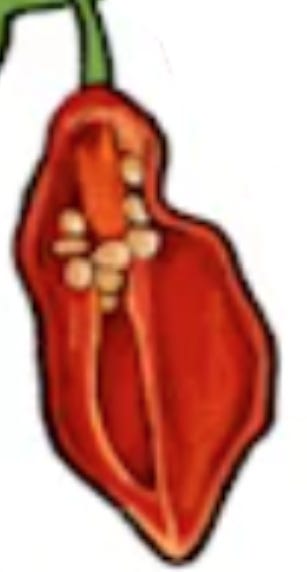
The anatomy of a ghost pepper reveals a sophisticated design centered on its potent biochemical defense mechanism. Its outer fruit wall is composed primarily of carbohydrates and fats. The flesh is shielded by a hydrophobic waxy layer designed to repel smaller invaders offering no assumed protection against the crushing force of mammalian teeth. Within the pepper lies the septae or “cartilage” which houses the placental region. This is where capsaicin, a potent alkaloid molecule is produced and stored. Because capsaicin is lipophilic ( fat-loving) and hydrophobic, it does not dissolve in water, which creates a volatile reaction in the mouth.
When you consume a ghost pepper or a concentrated spicy snack, your body’s natural digestive defenses work against you. As you chew, your brain triggers the production of saliva to aid in digestion. However, since saliva is roughly 98% water, it acts like a “waterfall” that spreads the hydrophobic capsaicin oils across every surface of your mouth. The oil bypasses the protective mucus layer on your palate, tongue, and inner cheeks which is normally there to help food particles stick together. It heads straight for your cells (the target). Since your cells are encased in fatty lipid bilayers, the fat-loving capsaicin can latch on and bind with ease.
The molecules lock into non-selective cation receptors, triggering a calcium signaling event to the brain. This activation of G-protein coupled receptors (GPCR) forces the brain to categorize the intake: Is this energy the body needs? Does this trigger nostalgia, dopamine or comfort? Is this being consumed simply for the pleasure of the experience?
It gets even crazier: while this protein-coupled signaling occurs on the molecular level, the actual human experience is that your mouth feels literally on fire. Most people reach for the wrong thing to stop it, and here is why:
Water: This is like river rafting a class 2 that quickly turns into a class 6 because of recent rainfall and whatnot. Since the spicy oils don’t dissolve in water, you are just rafting the fire to new parts of your mouth.
Bread: This assumes the spicy molecules haven’t already stuck to the mucus membranes. Bread can help a little, but it usually isn’t enough.
Milk: This is the winner winner chicken dinner. Milk creates a new complex with the alkaloid, effectively neutralizing the burn. (pro-tip: use labneh)